
A serviced accommodation property can look perfect during a viewing.
It may have spacious bedrooms, attractive décor and enough room to accommodate several guests. However, none of that matters if there is no strong reason for people to stay in the area.
One of the biggest mistakes new serviced accommodation investors make is choosing a property first and then trying to work out who might book it.
The process should happen in the opposite order:
Understand the area, identify the demand, establish the target guest and only then choose a suitable property.
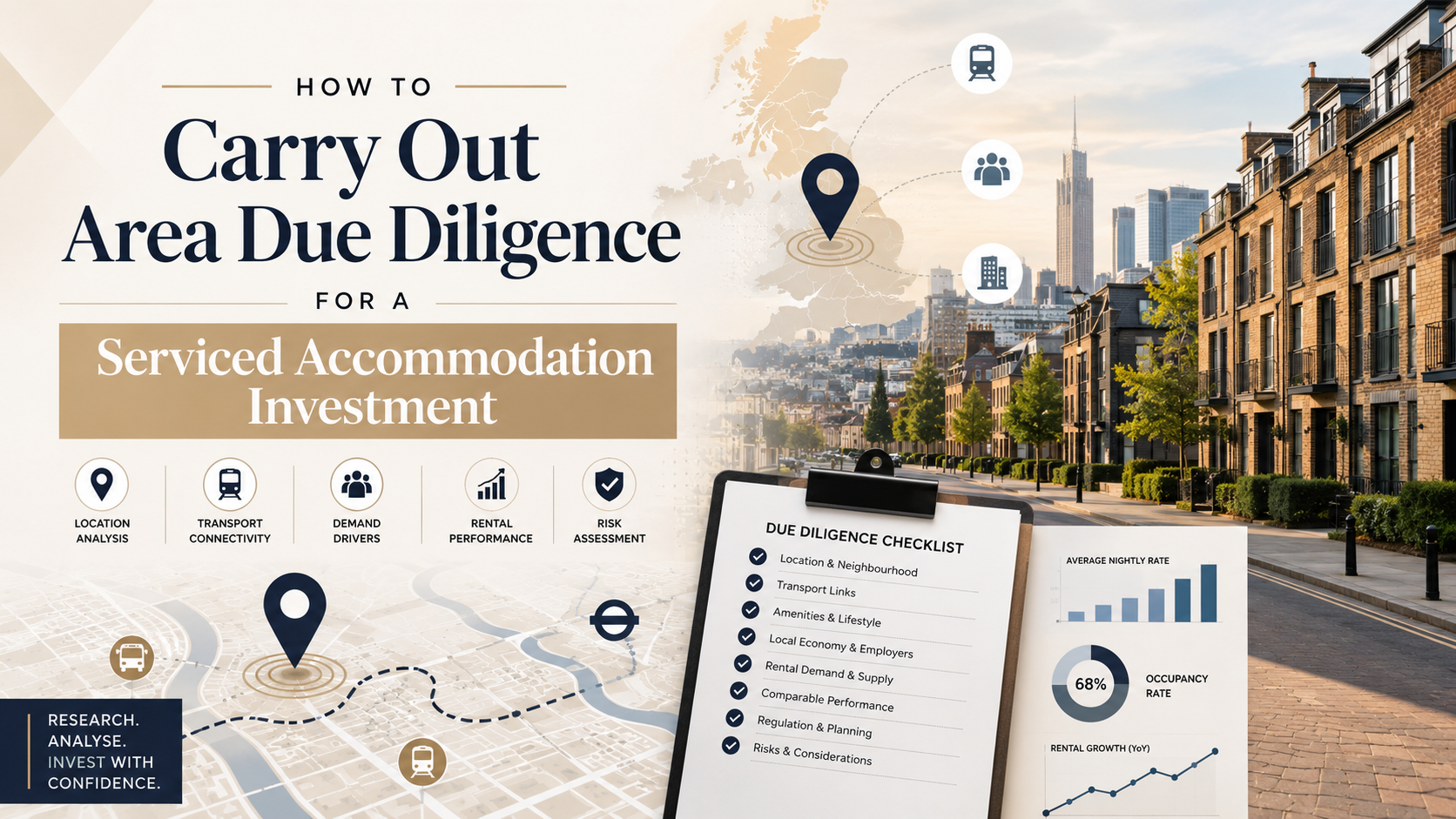
This is Part 1 of our three-part serviced accommodation due diligence series. It focuses on how to carry out area due diligence before committing to a property, paying a deposit or spending money on setup.
What is serviced accommodation?
Serviced accommodation is furnished accommodation offered to guests for short-term or medium-term stays.
Depending on the location, guests may include:
- Contractors
- Business travellers
- Corporate workers
- Leisure guests
- Families
- People relocating
- Insurance-placement guests
- Medical visitors
- People visiting friends or relatives
Contractors
Business travellers
Corporate workers
Leisure guests
Families
People relocating
Insurance-placement guests
Medical visitors
People visiting friends or relatives
Unlike a traditional rental property, serviced accommodation is an active operating business. The property needs to attract bookings, provide the facilities expected by its target audience and generate enough income to cover its operating costs.
That is why location research is so important.
A property is not automatically a good serviced accommodation investment because it is available, affordable or attractive.
Why location comes before the property
At Apex Stays, we have operated serviced accommodation in Bradford city centre through a challenging and price-sensitive market.
That experience has shown us that a successful listing needs more than professional photographs and attractive furnishings.
There must be genuine reasons for guests to visit the area.
A relatively simple property in a strong location may outperform a luxury apartment in an area with weak or inconsistent demand.
The first question should therefore be:
Why would somebody need to stay here?
The answer should be supported by evidence rather than assumptions.
Identify the local demand drivers
Demand drivers are the reasons people travel to and stay in a particular area.
The strongest serviced accommodation locations usually have several demand drivers rather than relying on one employer, project or annual event.
For example, an area may attract contractors during the week, leisure guests at weekends and families during school holidays.
That mix can provide a more balanced market and reduce dependence on one type of booking.
Research transport links and accessibility
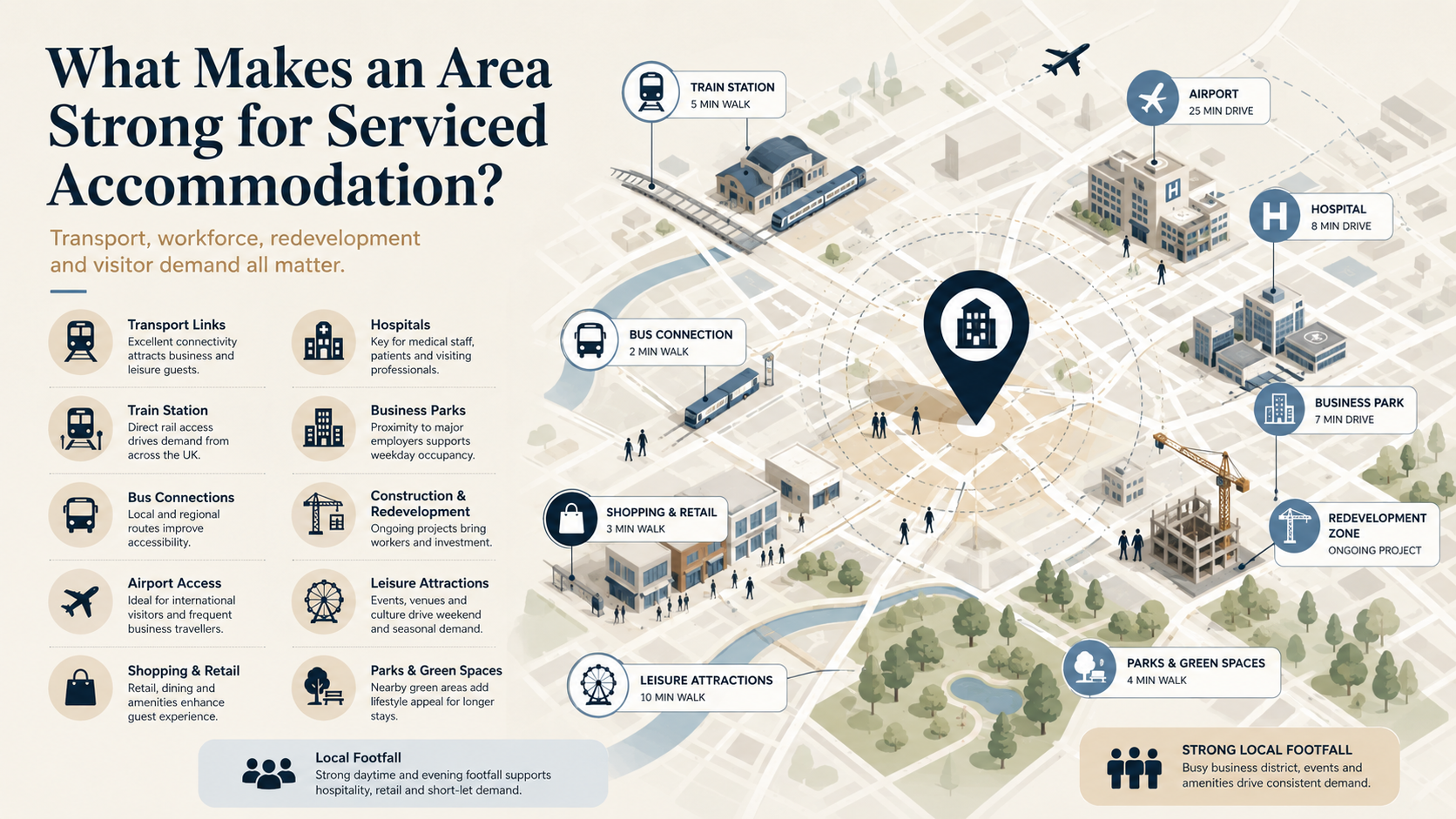
Good transport links can increase the number of guests willing to consider an area.
Your serviced accommodation area due diligence should include:
- Railway stations
- Bus and coach stations
- Airports
- Motorway access
- Major A-roads
- Public transport frequency
- Taxi availability
- Travel times to nearby cities
- Parking availability
- Electric vehicle charging
Railway stations
Bus and coach stations
Airports
Motorway access
Major A-roads
Public transport frequency
Taxi availability
Travel times to nearby cities
Parking availability
Electric vehicle charging
Do not rely only on the distance shown on a map.
A property may appear close to a city centre but take considerably longer to reach during rush hour. A nearby railway station may also be less useful if services are infrequent or require several changes.
Test the journeys your likely guests would actually make.
Ask:
- How long does it take to reach the nearest business district?
- Can contractors easily access nearby industrial estates?
- Is the airport genuinely convenient?
- Can leisure guests reach attractions without driving?
- Is the property easy to find after dark?
- Is suitable parking available nearby?
How long does it take to reach the nearest business district?
Can contractors easily access nearby industrial estates?
Is the airport genuinely convenient?
Can leisure guests reach attractions without driving?
Is the property easy to find after dark?
Is suitable parking available nearby?
Accessibility can affect both demand and the type of guest the property is best suited to.
Look for employment and contractor demand
Employment activity can create weekday bookings and longer stays.
Research the surrounding area for:
- Industrial estates
- Distribution centres
- Warehouses
- Manufacturing businesses
- Construction projects
- Infrastructure work
- Hospitals
- Universities
- Business parks
- Office districts
- Utility projects
- Major local employers
Industrial estates
Distribution centres
Warehouses
Manufacturing businesses
Construction projects
Infrastructure work
Hospitals
Universities
Business parks
Office districts
Utility projects
Major local employers
A large project may attract contractors, engineers, consultants, trainers and temporary management teams from outside the area.
However, the presence of one large employer does not guarantee consistent demand.
Investigate:
- How many people work there?
- Are temporary workers regularly brought into the area?
- How long is the project expected to continue?
- Which companies are involved?
- Are workers likely to need parking?
- Would they prefer houses, apartments or hotels?
- Are other accommodation providers already targeting them?
How many people work there?
Are temporary workers regularly brought into the area?
How long is the project expected to continue?
Which companies are involved?
Are workers likely to need parking?
Would they prefer houses, apartments or hotels?
Are other accommodation providers already targeting them?
An area supported by several employers and projects may be less risky than one relying entirely on a single construction site.
Investigate regeneration and local investment
Regeneration can create both immediate and long-term serviced accommodation demand.
Look for:
- Town-centre regeneration
- New housing developments
- Commercial construction
- Hospital expansions
- University investment
- Transport improvements
- New entertainment venues
- Business relocations
- Public-sector projects
- Major infrastructure work
Town-centre regeneration
New housing developments
Commercial construction
Hospital expansions
University investment
Transport improvements
New entertainment venues
Business relocations
Public-sector projects
Major infrastructure work
Construction may create temporary contractor demand, while the completed development could attract business travellers, residents’ families and leisure visitors.
The timescale is important.
A six-month refurbishment project should not be treated as permanent demand. A wider regeneration programme lasting several years could provide a stronger foundation.
Useful sources may include local council plans, planning applications, regional business news, construction announcements and company websites.
Assess leisure activities and visitor attractions
Leisure demand can help fill weekends, school holidays and event dates.
Potential demand drivers include:
- Theatres
- Music venues
- Football stadiums
- Sporting events
- Wedding venues
- Shopping centres
- Museums
- Heritage sites
- Parks
- Restaurants
- Nightlife
- Festivals
- Family attractions
- Nearby countryside
- Seasonal events
Theatres
Music venues
Football stadiums
Sporting events
Wedding venues
Shopping centres
Museums
Heritage sites
Parks
Restaurants
Nightlife
Festivals
Family attractions
Nearby countryside
Seasonal events
An attraction does not always need to be directly outside the property.
Guests may use serviced accommodation as a convenient or affordable base for visiting several nearby locations.
However, one popular annual event does not make an area viable for the rest of the year.
Investors should determine whether there are reasons for guests to visit during normal weeks as well as peak dates.
A location supported by events, employment, transport and family visits may be more resilient than one relying entirely on weekend leisure demand.
Consider hospitals, universities and family visits
Hospitals and universities can create several different types of accommodation demand.
These may include:
- Visiting medical professionals
- Temporary hospital staff
- Patients’ relatives
- Visiting lecturers
- Researchers
- Placement workers
- Families visiting students
- Graduation visitors
- People attending interviews
- People completing training
Visiting medical professionals
Temporary hospital staff
Patients’ relatives
Visiting lecturers
Researchers
Placement workers
Families visiting students
Graduation visitors
People attending interviews
People completing training
Family and friend visits are also often overlooked.
Guests may require accommodation when attending weddings, birthdays, funerals, graduations or other family occasions.
This demand can exist in areas that are not traditional tourist destinations.
Convenience still matters. A hospital may appear close on a map but be difficult to reach because of traffic, parking or poor public transport.
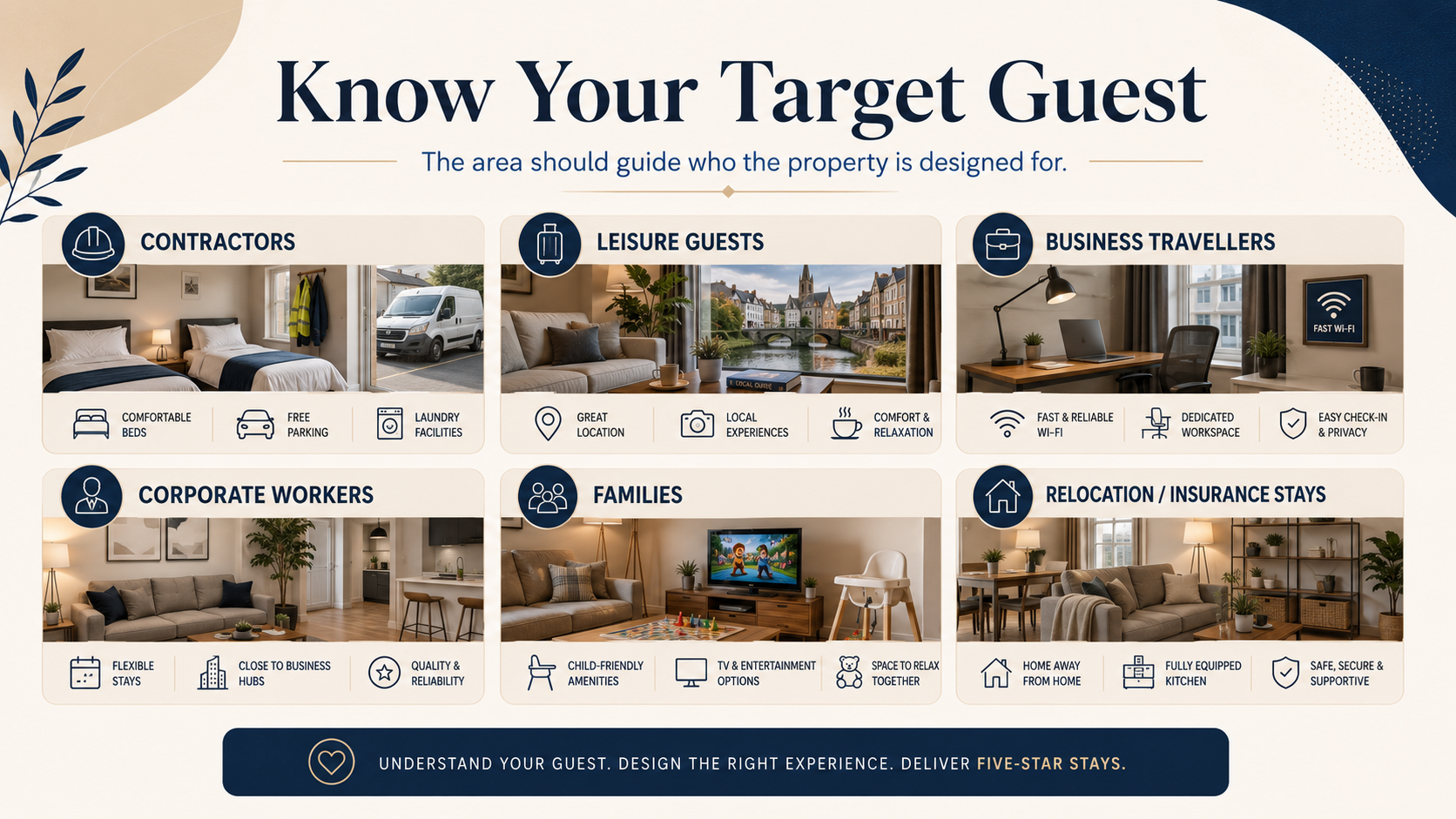
Identify the target guest
Once you understand why people visit the area, you can identify the most likely target market.
This is one of the most important stages of serviced accommodation area due diligence.
Contractors
Areas with construction, manufacturing, warehousing and infrastructure projects may attract contractor bookings.
They commonly value:
- Parking
- Easy road access
- Separate beds
- Nearby shops
- Practical kitchens
- Washing facilities
- Longer-stay discounts
Parking
Easy road access
Separate beds
Nearby shops
Practical kitchens
Washing facilities
Longer-stay discounts
Business and corporate travellers
Areas close to offices, business parks, transport hubs and city centres may attract business guests.
They are more likely to prioritise:
- Railway access
- Reliable Wi-Fi
- Quiet surroundings
- Professional presentation
- Flexible self-check-in
- Convenient journey times
Railway access
Reliable Wi-Fi
Quiet surroundings
Professional presentation
Flexible self-check-in
Convenient journey times
Leisure guests
Locations with attractions, events, restaurants, shopping and entertainment may suit leisure stays.
These guests may care more about:
- Central location
- Comfort
- Attractive presentation
- Strong reviews
- Local recommendations
- Easy access to attractions
Central location
Comfort
Attractive presentation
Strong reviews
Local recommendations
Easy access to attractions
Relocation and insurance stays
Residential areas close to schools, workplaces, transport and everyday amenities may attract longer temporary stays.
These guests could include:
- Families moving home
- Employees relocating for work
- People displaced by flooding or fire
- Households waiting for repairs to be completed
Families moving home
Employees relocating for work
People displaced by flooding or fire
Households waiting for repairs to be completed
These bookings may last several weeks or months and generally require a practical, homely environment.
An area may serve more than one target market, but trying to appeal to everybody can lead to unclear positioning.
The target guest should be based on the evidence found during your research.
Research existing serviced accommodation competition
Competition is not always a negative sign.
Established serviced accommodation listings can confirm that guests are already staying in the area.
The real question is whether there is enough demand for another suitable property.
Review comparable listings on Airbnb, Booking.com and other booking platforms.
Look at:
- Property type
- Number of bedrooms
- Guest capacity
- Bed arrangements
- Parking
- Amenities
- Presentation
- Review scores
- Recent review dates
- Weekday prices
- Weekend prices
- Minimum stays
- Weekly discounts
- Monthly discounts
Property type
Number of bedrooms
Guest capacity
Bed arrangements
Parking
Amenities
Presentation
Review scores
Recent review dates
Weekday prices
Weekend prices
Minimum stays
Weekly discounts
Monthly discounts
Compare like with like.
A premium two-bedroom apartment with parking should not be used as the main comparison for a basic studio without parking.
The strongest comparable properties should be similar in location, size, quality, guest capacity and facilities.
Blocked calendars do not always mean confirmed bookings
A heavily blocked calendar may appear to show strong occupancy.
However, blocked dates could represent:
- Confirmed bookings
- Owner use
- Maintenance
- Longer-term occupation
- Dates manually closed by the host
- Availability restrictions from another platform
- An inactive listing
Confirmed bookings
Owner use
Maintenance
Longer-term occupation
Dates manually closed by the host
Availability restrictions from another platform
An inactive listing
Calendar availability should therefore be treated as one source of evidence, not proof of bookings.
Recent reviews can provide additional clues.
A listing may have hundreds of historical reviews but very little recent activity. That could suggest the property is no longer operating as consistently as it once did.
Review several comparable properties across multiple months rather than relying on one listing.
Understand weekday and weekend demand
Not every serviced accommodation market performs consistently throughout the week.
A contractor-led area may be strongest from Monday to Friday but quieter at weekends.
A leisure-focused city centre may perform well on Fridays and Saturdays but struggle during ordinary weekdays.
Stronger locations may have overlapping demand:
- Contractors and corporate guests during the week
- Leisure guests during weekends
- Families during school holidays
- Events throughout the year
- Relocation and insurance stays during quieter periods
Contractors and corporate guests during the week
Leisure guests during weekends
Families during school holidays
Events throughout the year
Relocation and insurance stays during quieter periods
Investors should identify where gaps in demand are likely to appear.
A strong Saturday-night rate does not automatically create a profitable month.
Research the exact micro-location
Researching the town or city is not enough.
Two properties within the same postcode area can provide completely different guest experiences.
Consider:
- The immediate surroundings
- Street appearance
- Noise
- Lighting
- Guest perception of safety
- Parking restrictions
- Distance to shops
- Access to public transport
- Neighbouring businesses
- Late-night activity
- Communal entrances
- Walking routes
The immediate surroundings
Street appearance
Noise
Lighting
Guest perception of safety
Parking restrictions
Distance to shops
Access to public transport
Neighbouring businesses
Late-night activity
Communal entrances
Walking routes
Visit the location at different times where possible.
An area that appears quiet during an afternoon viewing may become noisy at night. Parking that is readily available during the day may disappear when residents return from work.
Think about how the area will feel to a guest arriving alone, in bad weather or late in the evening.
Warning signs during area due diligence
An area may require greater caution when:
- Demand depends on one temporary project.
- There is little evidence of existing guest activity.
- Comparable properties are heavily discounting.
- Recent reviews are limited.
- Transport links are weak.
- Parking does not suit the target market.
- Leisure demand exists only around occasional events.
- The market appears heavily seasonal.
- Similar properties are competing mainly on price.
- The property is too far from the main demand drivers.
- The target guest cannot be clearly identified.
Demand depends on one temporary project.
There is little evidence of existing guest activity.
Comparable properties are heavily discounting.
Recent reviews are limited.
Transport links are weak.
Parking does not suit the target market.
Leisure demand exists only around occasional events.
The market appears heavily seasonal.
Similar properties are competing mainly on price.
The property is too far from the main demand drivers.
The target guest cannot be clearly identified.
No single warning sign automatically makes an area unsuitable.
However, several concerns together may indicate that the opportunity carries more risk than the projected income suggests.
Area demand is only the first stage
Strong local demand does not automatically mean the final property will be profitable.
The rent, Council Tax position, platform fees, software, payment-processing charges, marketing and consumables must still be considered.
Our guide to the hidden costs of running a serviced accommodation business in the UK explains several smaller expenses that can reduce the amount of profit left at the end of the month.
Area due diligence helps establish whether guests are likely to stay in the location.
The next stages determine whether the property, agreement and financial figures allow the opportunity to work as a sustainable business.
How Apex Stays approaches area due diligence
At Apex Stays, we believe investment opportunities should be assessed using evidence rather than excitement.
Before considering whether a property could work as serviced accommodation, we look at:
- Why guests travel to the area
- The likely target market
- Local employment
- Contractor activity
- Transport connections
- Airports and railway stations
- Regeneration and development
- Leisure attractions
- Hospitals and universities
- Existing competition
- Weekday and weekend demand
- Seasonal risks
- The exact micro-location
Why guests travel to the area
The likely target market
Local employment
Contractor activity
Transport connections
Airports and railway stations
Regeneration and development
Leisure attractions
Hospitals and universities
Existing competition
Weekday and weekend demand
Seasonal risks
The exact micro-location
Area due diligence cannot guarantee that a property will succeed.
What it can do is uncover weaknesses before an investor commits money to rent, deposits, furniture and setup costs.
You can learn more about our approach to researching and sourcing opportunities across West Yorkshire through the Apex Stays serviced accommodation investor page.
The final takeaway
A serviced accommodation investment should not begin with a property viewing.
It should begin with one question:
Why would guests need to stay in this area?
The answer should lead you towards the likely target market, the correct property type and the facilities guests will expect.
A location with several demand drivers, useful transport connections and a clearly identifiable target audience may provide a stronger foundation than an attractive property selected without proper research.
The correct order is:
Find the demand. Identify the guest. Then choose the property.
In Part 2 of this serviced accommodation due diligence series, we will explain how to assess whether a property is genuinely suitable for the target market identified during the area research.

Interested in property opportunities?
Join our WhatsApp Deal Group for direct access to selected property deals, operator insights and serviced accommodation breakdowns across West Yorkshire.