

Artificial intelligence is changing the way people communicate, research problems and challenge decisions.
That includes tenants.
Recent reporting from The Times highlighted how tenants are now using AI tools such as ChatGPT to challenge letting agents and landlords over issues such as deposit deductions, poor service and unclear communication. The article gave examples of renters using AI to review documents, understand their rights and create stronger written responses when they believed a deduction or decision was unfair.
For landlords, this is not something to panic about.
In many ways, better-informed tenants can lead to clearer communication and fairer outcomes. If a landlord is acting properly, keeping good records and making reasonable decisions, AI should not automatically be a problem.
The real risk is different.
If records are weak, deductions are vague, photos are missing, invoices are unclear, or communication has been poor, tenants now have easier tools to challenge those gaps.
For landlords across West Yorkshire, especially those managing properties in Bradford, Leeds, Halifax, Huddersfield, Wakefield, Keighley and surrounding areas, this is another reminder that property management is becoming more evidence-led.
The question is no longer just:
“Am I doing the right thing?”
It is also:
“Can I prove I did the right thing?”
AI Is Not the Problem — Poor Records Are
It would be easy to frame this as a landlord-versus-tenant issue.
But that is not the right way to look at it.
Tenants have always been able to challenge deductions, complain about poor repairs, dispute charges or ask for evidence. The difference is that AI makes the process easier.
A tenant can now use AI to:
- Draft a more professional email
- Understand deposit rules
- Question vague deductions
- Compare a landlord’s claim against tenancy documents
- Organise their evidence
- Ask what records they should request
- Challenge poor communication
- Prepare a stronger response for a deposit dispute
Draft a more professional email
Understand deposit rules
Question vague deductions
Compare a landlord’s claim against tenancy documents
Organise their evidence
Ask what records they should request
Challenge poor communication
Prepare a stronger response for a deposit dispute
That does not mean the tenant is automatically right.
It simply means landlords and agents need to be better prepared.
If the landlord has a clear tenancy agreement, signed inventory, dated photos, check-in and check-out reports, invoices, receipts and communication records, a tenant using AI should not be a major issue.
But if the landlord is relying on memory, blurry photos, vague messages or assumptions, disputes become much harder to defend.
Why This Matters More in 2026
The private rental sector has already changed significantly.
From 1 May 2026, the Renters’ Rights Act 2025 introduced new rules for many private landlords and tenants in England. GOV.UK says the Act gives tenants new rights and introduces new rules for private landlords.
GOV.UK also states that most landlords and agents had to give tenants the official Renters’ Rights Act Information Sheet by 31 May 2026, with potential fines of up to £7,000 for failing to do so.
This matters because tenants are becoming more aware of their rights at the same time that AI tools are making it easier for them to act on that information.
For landlords, this creates a clear message:
Good property management now needs good documentation.
This is especially important for landlords who self-manage. If there is no agent, no professional inventory clerk and no structured system, it is easy for records to become scattered across text messages, emails, photos, WhatsApp chats, paper documents and memory.
That can create problems later.
Deposit Deductions Are One of the Biggest Risk Areas
Deposit disputes are one of the most obvious areas where AI can make a difference.
A tenant who receives a deduction they do not understand can now ask AI to help them challenge it. They may ask whether the deduction is reasonable, what evidence they should request, and how to write a response.
Again, this does not mean the tenant will win.
But it does mean the landlord’s evidence needs to be strong.
The Tenancy Deposit Scheme says that to justify a deduction for missing items, landlords need evidence such as proof the item was supplied, a signed inventory and photos, proof it was missing at check-out, proof of value and a reasonable calculation that considers age and condition.
For cleaning disputes, TDS also lists useful evidence such as check-in and check-out reports, cleaning invoices, photos and communication with the tenant.
The Deposit Protection Service gives similar guidance, saying check-out evidence may be vital to the success of a deposit claim and that the best evidence usually includes dated photos, tenant signatures and third-party prepared records where possible.
This is where many landlords can get caught out.
They may be right that the property was left dirty or damaged. But if they cannot prove the starting condition, the ending condition and the cost of putting it right, the deduction may be difficult to justify.
Fair Wear and Tear Needs to Be Understood Properly
One of the most common mistakes landlords make is treating every change in condition as damage.
That is risky.
A tenant is not usually responsible for the property looking exactly the same after living there for a period of time. Normal use, ageing and reasonable wear must be considered.
This is where good evidence matters.
A landlord should be able to show:
- What condition the item was in at the start
- How old the item was
- What condition it was in at the end
- Whether the issue goes beyond fair wear and tear
- Whether the amount being claimed is proportionate
What condition the item was in at the start
How old the item was
What condition it was in at the end
Whether the issue goes beyond fair wear and tear
Whether the amount being claimed is proportionate
For example, claiming the full replacement cost of an old item may not be reasonable if the item had already had years of use.
A better approach is to keep clear evidence and make deductions that are fair, proportionate and explainable.
If a tenant uses AI to challenge the deduction, a clear evidence trail gives the landlord a much stronger position.
Maintenance Complaints Are Another Area to Watch
AI is not only useful for deposit disputes.
Tenants may also use it to challenge delays with repairs, poor communication or unresolved maintenance issues.
This is where landlords need to think carefully about communication records.
If a tenant reports damp, mould, a leak, heating issues or an electrical fault, the landlord should keep a clear timeline of what happened.
That might include:
- Date the issue was reported
- Photos or videos provided
- Response sent to the tenant
- Contractor contacted
- Appointment booked
- Work completed
- Invoice received
- Follow-up message sent
- Any tenant delays or access issues
Date the issue was reported
Photos or videos provided
Response sent to the tenant
Contractor contacted
Appointment booked
Work completed
Invoice received
Follow-up message sent
Any tenant delays or access issues
This does not just protect the tenant. It protects the landlord too.
Without a record, it can become one person’s word against another’s.
With a record, the facts are clearer.
Rent Arrears and Disputes Also Need Clear Timelines
Rent arrears are another area where landlords should avoid relying on informal notes or memory.
If a tenant falls behind, landlords should keep a clear record of:
- Rent due dates
- Payments received
- Missed payments
- Messages sent
- Payment plans agreed
- Any promises made by the tenant
- Any formal notices served
- Any support or reasonable adjustments offered
Rent due dates
Payments received
Missed payments
Messages sent
Payment plans agreed
Any promises made by the tenant
Any formal notices served
Any support or reasonable adjustments offered
This matters because if a dispute escalates, the landlord needs to show what happened and when.
Clear records also help landlords stay calm and professional.
When things are not written down properly, communication can become emotional, inconsistent or unclear. That rarely helps.
What West Yorkshire Landlords Should Start Documenting Properly
For landlords across West Yorkshire, especially those managing their own properties, this is a good time to review what is being recorded.
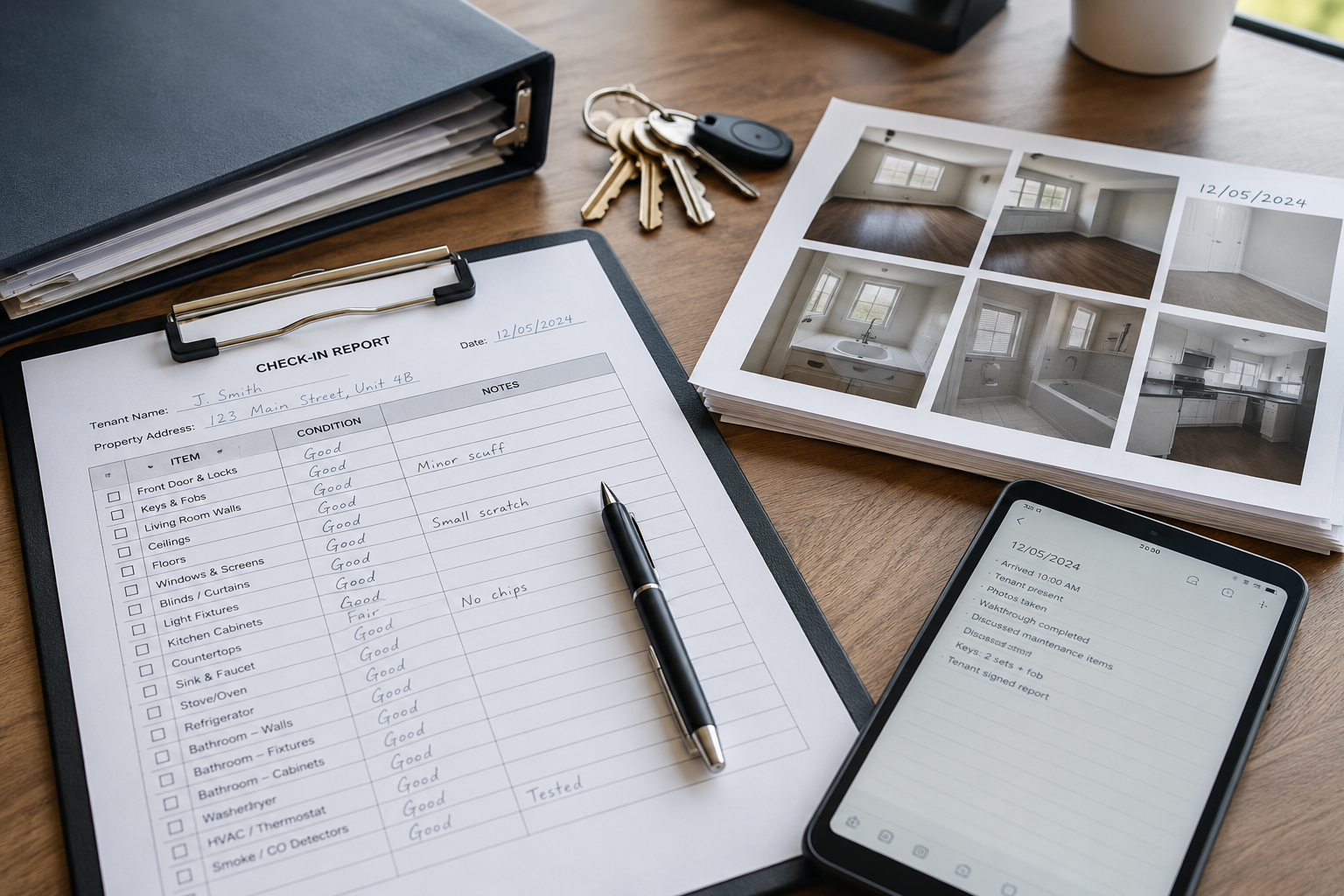
A basic landlord evidence system should include:
1. A clear tenancy agreement
Make sure the agreement is stored safely and easy to access. If a dispute happens, both sides need to understand what was agreed.
2. A signed inventory
This should clearly show the condition of the property at the start of the tenancy.
3. Check-in photos or videos
Photos should be clear, dated and detailed. Blurry or random photos are much weaker.
4. Check-out report
The check-out report should compare the end condition with the starting condition.
5. Maintenance records
Every repair should have a basic trail: report, response, contractor, invoice and completion.
6. Tenant communication
Emails, messages and letters should be stored properly. Important agreements should not be left only in casual conversations.
7. Rent records
Keep a clean record of rent due, rent received and arrears.
8. Safety certificates
Gas, electric, fire safety and other compliance documents should be organised and up to date where required.
9. Invoices and receipts
If you want to claim money from a deposit, you need to show the cost clearly.
10. Evidence of information given to tenants
This is increasingly important under the newer rental rules. GOV.UK says landlords had to provide the Renters’ Rights Act Information Sheet to most tenants by 31 May 2026.
The goal is not to create unnecessary admin.
The goal is to protect both sides by making the facts clear.
What Landlords Should Avoid
Landlords should avoid:
- Making vague deductions
- Charging for improvements rather than genuine loss
- Claiming full replacement cost without considering age and condition
- Relying on old or blurry photos
- Failing to provide invoices
- Ignoring tenant messages
- Letting repairs drag without communication
- Keeping records across too many places
- Responding emotionally during disputes
- Assuming the tenant does not understand their rights
Making vague deductions
Charging for improvements rather than genuine loss
Claiming full replacement cost without considering age and condition
Relying on old or blurry photos
Failing to provide invoices
Ignoring tenant messages
Letting repairs drag without communication
Keeping records across too many places
Responding emotionally during disputes
Assuming the tenant does not understand their rights
Tenants are becoming more informed.
That is not necessarily a bad thing. But it does mean landlords need to be more professional.
Can Landlords Use AI Too?
Yes — but carefully.
AI can help landlords organise thoughts, draft professional responses, create checklists and understand what evidence may be useful.
For example, landlords could use AI to help:
- Draft a polite response to a tenant complaint
- Create a maintenance timeline
- Build an inventory checklist
- Summarise a long email chain
- Prepare questions for a letting agent or solicitor
- Improve clarity in communication
Draft a polite response to a tenant complaint
Create a maintenance timeline
Build an inventory checklist
Summarise a long email chain
Prepare questions for a letting agent or solicitor
Improve clarity in communication
However, landlords should not rely on AI as legal advice.
AI can make mistakes. It may misunderstand the law, miss important details, or produce wording that sounds confident but is not correct.
For legal notices, possession, deposit disputes, compliance issues or serious tenant problems, landlords should get proper advice from a qualified professional.
This Is About Professional Standards, Not Taking Sides
A fair rental market should not depend on one side being confused.
Tenants should understand their rights.Landlords should understand their responsibilities.Both sides should have access to clear information.
The issue is not that tenants are using AI.
The issue is whether landlords have the systems, evidence and communication standards to manage property properly in a more informed market.
For some landlords, this will be simple.
They may already have good records, a reliable agent and a clear process.
For others, this could be a wake-up call.
If managing the property already feels stressful, the extra pressure of disputes, documentation and compliance may make the landlord question whether they want to continue self-managing.
That does not mean they need to sell.
It means they may need to review their options.
What Options Do Landlords Have?
If you are a landlord and you feel like the admin, disputes and compliance side of property management is becoming harder, there are several routes you could consider.
Option 1: Improve your self-management systems
This may include better record keeping, clearer communication templates, regular inspections, digital storage, stronger inventories and better maintenance tracking.
This can work well if you still want to manage the property yourself.
Option 2: Use a letting agent
A good letting agent may help with tenant communication, rent collection, compliance reminders, inspections and deposit handling.
This can reduce your involvement, although the quality of agents can vary.
Option 3: Use an independent inventory clerk
This can be especially useful at the start and end of tenancies.
A professional inventory can make disputes easier to evidence and harder to argue emotionally.
Option 4: Review whether the property still works as a traditional rental
Traditional buy-to-let can still work well, but landlords should review the full picture: rent, costs, tenant demand, condition, compliance, management time and stress.
We covered this in more detail in our previous guide: Is Your Rental Property Still Working for You?
Option 5: Review the impact of recent rental law changes
The Renters’ Rights Act has changed how many landlords need to think about tenancy structure, documentation, rent increases and property strategy.
You can read our related guide here: Renters’ Rights Act: What West Yorkshire Landlords Should Review in 2026
Option 6: Explore a more managed property strategy
Some landlords may decide they want to keep the property but reduce their day-to-day involvement.
This could mean a fully managed letting agent, supported living provider, social housing provider, corporate let arrangement, or serviced accommodation management.
None of these options are automatically better than the others.
Each has pros, cons, risks, compliance requirements and suitability questions.
The right choice depends on the property, location, numbers, condition and landlord’s goals.
Final Thoughts
AI is not going away.
Tenants are likely to keep using it to understand their rights, question deductions, challenge poor communication and prepare stronger responses.
For good landlords, this should not be seen as a threat.
It should be seen as a reminder.
The landlords who are best prepared will be the ones with clear records, fair processes, strong communication and proper evidence.
For West Yorkshire landlords, the key question is not whether tenants are using AI.
The key question is:
Would your records stand up if they did?
If the answer is yes, you are likely in a much stronger position.
If the answer is no, now may be the right time to improve your systems, review your management process, or consider whether a more professional management route would suit your property.
You can find more landlord guides on the Apex Stays blog, including practical articles for West Yorkshire landlords reviewing property strategy, tenant issues, compliance and rental performance.
How Apex Stays May Be Able to Help
At Apex Stays, we work with selected landlords across West Yorkshire who want to understand whether their property could be suitable for professionally managed serviced accommodation.
This is not suitable for every property, and we do not believe landlords should make decisions based on guesswork.
A proper review should consider the property type, location, likely demand, condition, running costs, compliance, management requirements and risk.
For some landlords, the best option may still be traditional letting.For others, it may be improving their existing management process.Some may choose to sell.And some may want to explore a more hands-off managed route.
If your current rental setup is becoming difficult to manage, or if you want to understand whether your property could work under a different strategy, you can request a free landlord property review.
Request a Free Landlord Property Review
Are tenants really using AI to challenge landlords?
Yes. Recent reporting from The Times highlighted tenants using AI tools such as ChatGPT to challenge letting agents and landlords over deposit deductions, poor service and disputes.
Should landlords be worried about tenants using AI?
Not necessarily. If a landlord has good records, clear communication, proper evidence and fair deductions, AI should not automatically be a problem. The risk is greater when records are weak or deductions are vague.
What evidence do landlords need for deposit deductions?
Useful evidence can include a signed inventory, check-in and check-out reports, dated photos, invoices, receipts, communication records and proof of value. TDS says missing item deductions should be supported by evidence such as proof the item was supplied, proof it was missing at check-out, proof of value and a reasonable calculation.
Can tenants dispute deposit deductions?
Yes. GOV.UK says tenants can raise a dispute through an approved tenancy deposit protection scheme if there is a disagreement.
Can landlords use AI too?
Yes, landlords can use AI for admin support, checklists, draft responses and organisation. However, AI should not replace professional legal, tax or compliance advice.
What should West Yorkshire landlords review?
Landlords should review tenancy documents, inventories, photos, maintenance records, communication logs, rent records, compliance documents and whether their current management approach still suits their goals.

Considering a different approach for your property?
Discover how Apex Stays helps West Yorkshire landlords through professional Airbnb management or hands-off company let solutions.